


Sleeping alone outdoors is one thing. Sleeping as a couple introduces a completely different set of challenges. It usually starts the same way:
A couple drives five hours to a mountain campsite. They bring a compact air mattress to save space. It fits in the tent, but barely. By midnight, both are constantly adjusting their positions. One wakes up because the other moves. By morning, they're both tired, not because of the outdoors, but because their sleeping setup didn't support two people properly.
These experiences highlight an important truth: a comfortable night outdoors requires more than just a standard mattress. A well-designed air bed for couples needs to balance space, stability, insulation, and durability, all working together to create a restful camping experience.
To better understand what makes a difference, it's important to look at each of these factors more closely.
#1 Space Matters More Than You Think
Starting with one of the most commonly overlooked: space.
Many couples assume that any double-size air mattress will be enough. However, camping introduces different conditions compared to sleeping at home. Inside a tent, space is more limited, gear is often placed nearby, and movement during sleep becomes more noticeable.
For example, after a long day of hiking, both partners may naturally shift positions during the night. On a smaller mattress, this movement can quickly disturb the other person. Over time, limited space leads to poor sleep quality and discomfort.

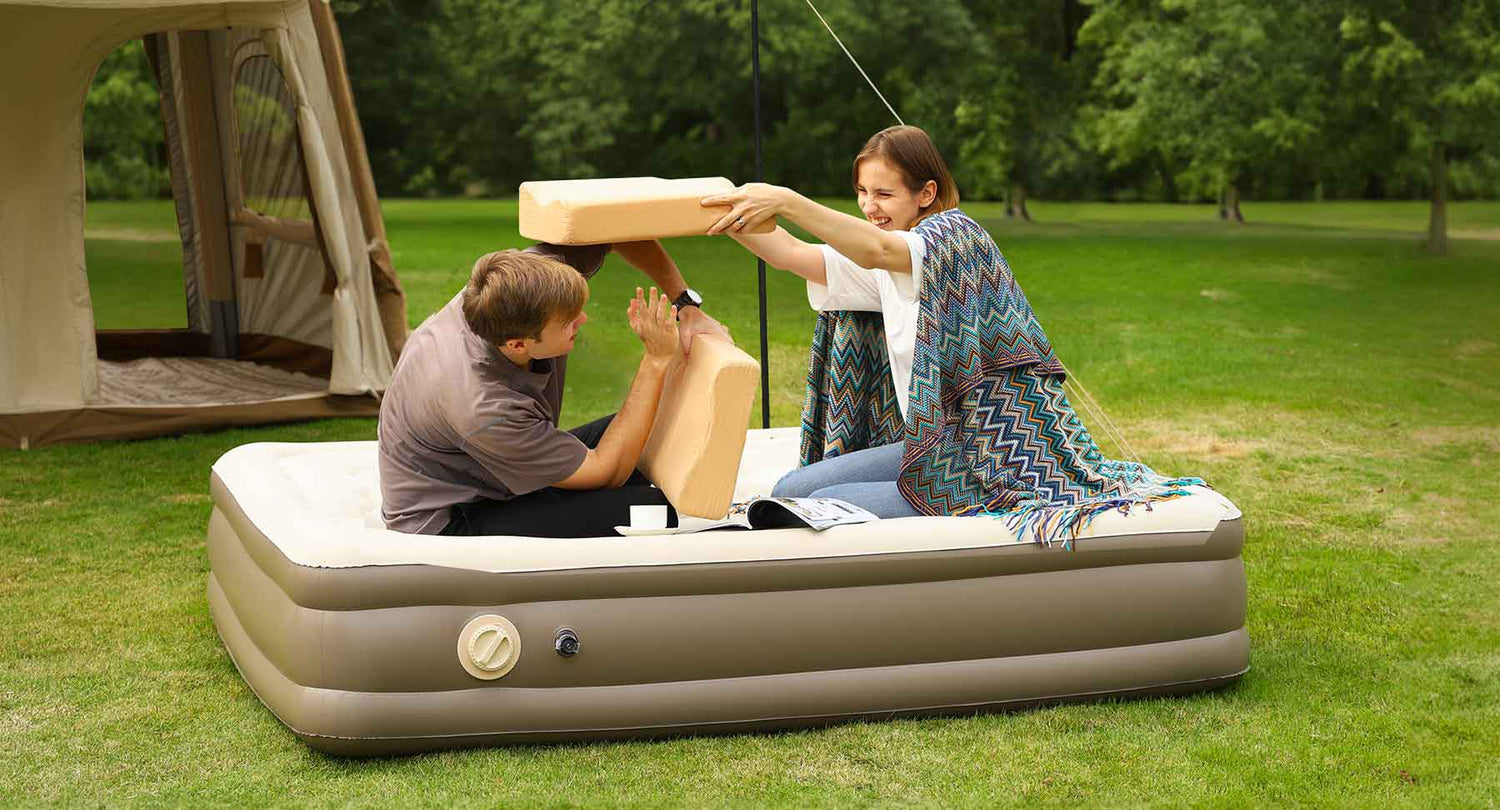
That’s why most couples find that Queen-size air mattresses or larger air beds offer a more comfortable experience. A wider sleeping surface allows both partners to move naturally without disturbing each other. It also helps reduce the feeling of rolling toward the center, a common issue with smaller air mattresses.
However, space isn’t just about comfort. It’s also about practicality.
Couples often bring additional gear, extra blankets, or even pets. A properly sized air bed for couples provides enough room to sleep comfortably without feeling crowded.
[[aerogogo-air-bed]]
Choosing the right size also means the tent dimensions. A mattress that fits perfectly inside your tent ensures better airflow, easier movement, and overall improved camping comfort.
#2 Height: The Silent Comfort Factor
Height is one of the most overlooked features when couples shop for an air bed, but it's one of the most impactful.
A low-profile air mattress may seem fine during setup. But once you're lying down, you'll quickly notice how close you are to the cold ground. The lower the mattress, the more cold air transfers through it during the night.
Couples often find that 13 to 18 inches provides the best balance of comfort and stability.

Higher air beds offer several real-world advantages:
- They make it easier to sit, stand, and move in the tent.
- They provide better insulation from cold ground.
- They feel more like a traditional bed.
- They reduce motion transfer between partners.
Imagine waking up early in the morning. One partner wants to step outside for coffee while the other stays asleep. A higher air bed makes that movement quieter and smoother, small details that improve the overall experience.
For colder climates or shoulder-season camping, height becomes even more important. Staying slightly elevated from the ground can make the difference between waking up refreshed or waking up cold and stiff.
#3 Stability: Because One Person Always Moves
Every couple knows this truth: one person always moves more than the other.
This becomes especially noticeable when sleeping outdoors. Cheap air mattresses often behave like waterbeds. When one partner shifts, the entire surface moves.
- Look for double-welded seams or co-molded seams, which reduce the risk of leaks.
- Internal support structures like coil-beam or air-chamber designs improve stability and reduce sagging under weight. In real camping scenarios, this matters more than most people expect.
Imagine falling asleep after a long hike. You're exhausted and finally comfortable. Your partner turns over during the night, but instead of bouncing, the mattress absorbs the movement. You stay asleep.
Tip: Another option is to use two high-quality single sleeping pads with a side connector. This setup allows each person to have their own mattress while still forming a larger double bed. It reduces motion transfer and gives each sleeper individual support, which can be particularly useful for campers who prefer different firmness levels.

[[self-inflating-sleeping-pad-for-camping]]
#4 Insulation and Warmth
Outdoor temperatures often drop significantly overnight. Even during summer camping trips, ground temperatures can become surprisingly cold. Without proper insulation, couples may wake up feeling uncomfortable.
One key factor in choosing a sleeping pad for camping is the R-value, which measures a mattress’s resistance to heat loss. The higher the R-value, the better the insulation from cold ground. For example:
- R-value 1–2: Suitable for warm-weather camping only
- R-value 3–4: Good for 3-season camping (spring, summer, fall)
- R-value 5+: Suitable for colder conditions, including high-altitude or winter camping
A well-designed air bed for couples balances stability, comfort, and insulation. Thicker materials, air chamber designs, and supportive construction all contribute to improved warmth, and you can also choose soft blankets as additional accessories. This combination helps improve insulation, maintain body heat, and adds convenience for a more comfortable camping sleep.
Overall, insulation isn’t just about staying warm; it also improves sleep quality. Maintaining a comfortable body temperature throughout the night reduces disturbances and supports better recovery for active days outdoors.
#5 Material Thickness and Type
Camping environments are rarely perfect. Uneven ground, small rocks, temperature fluctuations, and repeated inflation/deflation cycles all place stress on sleeping gear. For couples, durability is even more critical because the mattress must support more weight and movement over time.
- High-quality camping air beds typically use PVC or TPU with a thickness of 0.4–0.6 mm for the sleeping surface and 0.5–0.7 mm for the bottom layer.
- TPU (thermoplastic polyurethane) offers better puncture resistance, is quieter, and handles temperature changes more effectively than standard PVC.
A reliable air bed for couples maintains its shape, inflation, and support under real-world conditions.
[[aerogogo-air-mattress-gm2]]
#6 Durability: Outdoor Conditions Are Unpredictable
For couples, reliability is not just about durability; it’s about consistent support throughout the night. Even high-quality mattresses can lose air over time, so it’s important to consider leak resistance and air retention, such as the manufacturer’s guaranteed hold time (typically 8–10 hours or more) and self-sealing valves that minimize overnight air loss.
Outdoor use also exposes sleeping pads to temperature fluctuations, UV light, and cold ground. Reliable mattresses are designed to withstand temperatures from -10°C to 40°C and often include UV-resistant coatings to protect the material during prolonged outdoor exposure.
#7 Weight Capacity: A Hidden but Important Factor
Reliable mattresses should comfortably support the combined weight of two adults. Market standards for couples’ air beds range from 500–800 lbs (227–363 kg). A higher weight rating generally indicates stronger materials and better structural support.
The Final
We hope this guide, with all the tips and considerations we’ve shared — from space, height, and stability to insulation, material, and reliability — helps you choose the right air bed for couples. With the right mattress, you and your partner can enjoy a more comfortable, restful, and enjoyable camping experience together.


发表评论
此站点受 hCaptcha 保护,并且 hCaptcha 隐私政策和服务条款适用。