




Most riders have experienced it without realizing it:
One ride feels fast, responsive, and smooth. The next—on the same bike, same route feels sluggish, unstable, or just slightly off. Often, the difference comes down to something small: tire pressure.
The reality is simple: Small inconsistencies in pressure can translate directly into noticeable differences in performance.
This guide takes a closer look at what actually matters when choosing a bicycle pump, from pressure accuracy and valve behavior to real-world usability, helping you choose the right solution for your riding style.
Why Pressure Accuracy Matters?
Tire pressure isn’t just a number; it directly changes how your bike interacts with the ground.
- Road bikes: Pressure affects rolling resistance, comfort, and grip
- Mountain bikes: Pressure determines traction, cornering stability, and pinch-flat resistance
- Gravel bikes: Pressure balancing becomes even more critical across mixed terrain
Many riders adjust pressure in increments as small as 2–3 PSI to dial in performance. Which raises an important question:
How accurately can you actually set that pressure?
In reality, this is far from true. Floor pump gauges can vary by ±3–5 PSI, while mini pumps rarely provide reliable pressure readings at all. Even small discrepancies can noticeably affect ride feel. Ultimately, tire pressure is defined by what your pump delivers. If your pump cannot deliver consistent and accurate pressure, your setup is already compromised.
Because of this, choosing the right pump isn’t just about convenience; it starts with compatibility and precision.
Understanding Valve Types
Before choosing a pump, you need to know your valve type. There are two main valve standards in cycling: Schrader and Presta.
Presta vs. Schrader
Schrader valves are the larger, more familiar type, commonly found on car tires and entry-level or commuter bikes. They use an internal spring to keep the valve closed, which means inflation is straightforward: attach the pump head and start pumping. In many cases, you can even use a gas station air pump.
Presta valves are thinner and require a bit more interaction. Before inflating, you need to unscrew the valve tip to open it. You can also tap it lightly to release small amounts of air when fine-tuning pressure.
Quick Comparison:
- Schrader → convenience and familiarity
- Presta → lighter weight and stronger rims
That’s why Presta valves are typically found on higher-performance bikes, where weight and rim integrity matter more than convenience.
Valve length also matters, especially on deeper rims. Aero wheels often require longer valves to reach through the rim. While extenders are an option, longer valves are generally easier to work with in practice.
Valve Length and Rim Depth
Valve length matters, especially for deep-section or aero wheels.
- Shallow rims → standard valve length
- Deep rims → longer valves required
- Valve extenders → optional but less convenient
In practice, longer valves are easier to use than extenders.
Choosing the Right Pump Type
#1 Floor Pumps (Track Pumps)
For most riders, the floor pump is the most important.
Why?
Most inflation happens before the ride at home.
They offer:
- Stability
- Higher air volume per stroke
- Integrated pressure gauges
However, accuracy varies widely. A quality pump with a reliable gauge makes a noticeable difference.
Expert Tip: Use a pump with a gauge.
Without it, you’re guessing, and small pressure differences matter more than most riders think.
#2 Portable Bike Pumps for Emergencies
A floor pump isn’t something you’d carry with you on a ride. That’s where portable pumps come in. They’re compact, lightweight, and ideal for flat repair kits, which means you can have something that will pump up your tires that is also portable.
Modern portable electric pumps take this a step further.
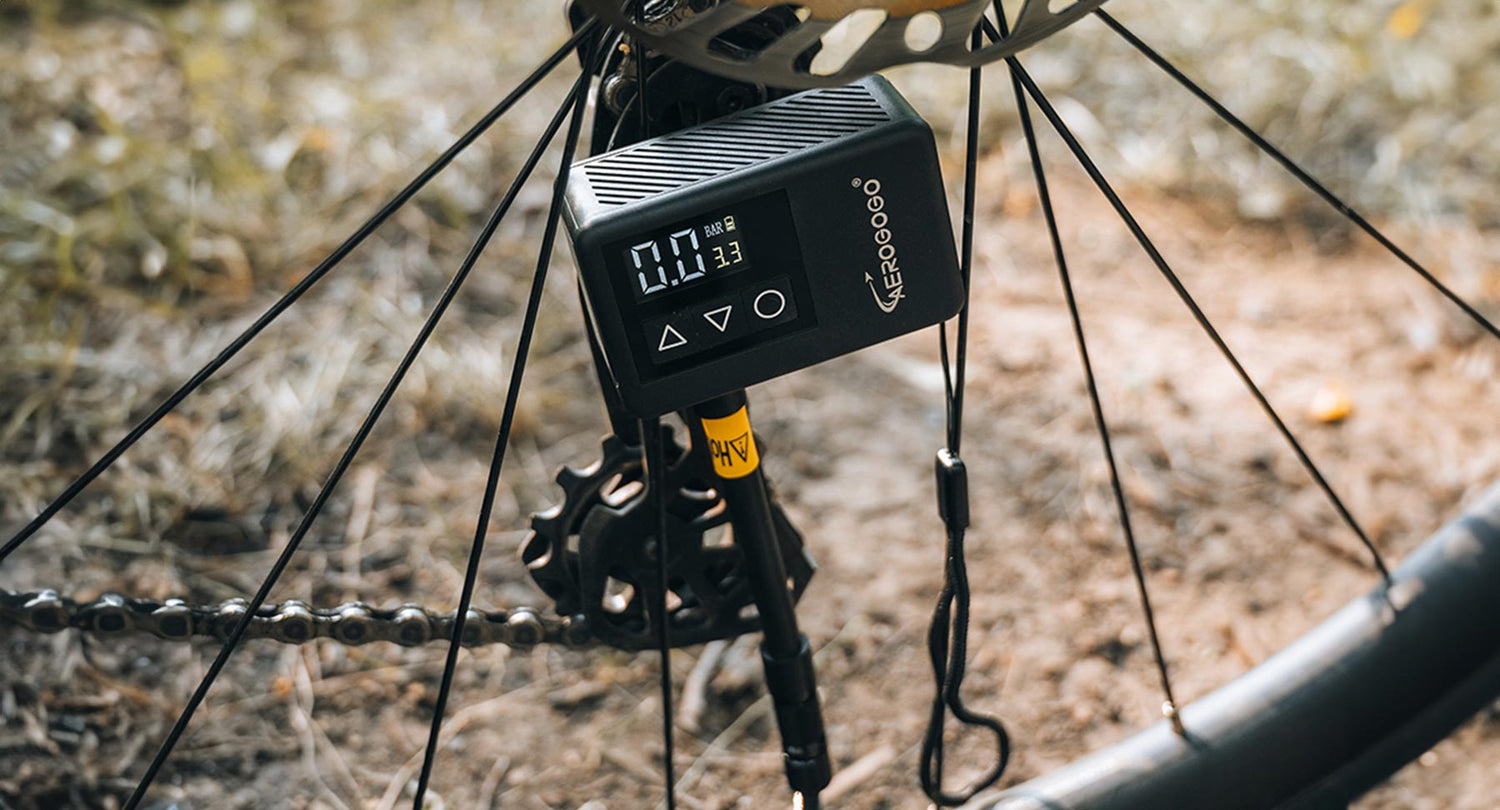
Unlike manual pumps, portable electric models also reduce user variability. Instead of relying on stroke technique or physical effort, they deliver air at a controlled rate and can automatically stop once the target pressure is reached. For example, compact electric pumps like the Mini Giga Pump combine portability with high-pressure capability, often reaching up to 120 PSI for bike tires while weighing as little as 108g (3.8 oz). More importantly, they allow riders to inflate tires to a precise target pressure without the inconsistencies that can come with manual pumping.
[[mini-giga-pump-for-cycling]]
This makes electric pumps particularly useful for riders who value convenience, accuracy, and repeatable setups across different rides.
#3 Shock Pumps
There’s also another type of pump: the shock pump.
This is designed specifically for suspension systems like forks and rear shocks. It operates at very high pressure (up to 300 PSI) but with extremely low air volume.
While it can technically inflate a tire, it’s not practical. Likewise, a regular floor pump isn’t suitable for suspension. Each pump is designed for a specific purpose.
Choosing the Right Pump for Your Riding Style
Road Cyclists
Road cyclists typically ride at higher PSI, often between 80 and 120, where small differences in pressure can significantly affect speed, rolling resistance, and ride feel. For this reason, a high-quality floor pump with an accurate gauge is essential for pre-ride inflation at home, ensuring precise, repeatable pressure every time. For riders who want on-the-go adjustments, a portable electric pump can provide reliable accuracy without the variability of manual pumping, making it a convenient backup for long rides or gravel detours. Shock pumps are generally unnecessary for road tires.Mountain Bikers
Mountain bikers ride with lower PSI, usually around 20 to 40, where traction and stability are more important than high pressure. A floor pump is still useful for home setup, but trail-side adjustments are common, so a lightweight portable pump is often indispensable. For riders with air-sprung suspension forks or rear shocks, a shock pump becomes essential to accurately dial in suspension pressure, ensuring optimal performance on technical trails.Gravel Riders
Gravel riders frequently fine-tune their tire pressure to balance comfort, grip, and efficiency across mixed terrain. A floor pump with a precise gauge helps set baseline pressures before heading out, while a portable pump that allows small, consistent adjustments is valuable for longer rides where terrain may vary. Electric models can also be a smart choice for riders who want accuracy without manual effort, especially for multiple tire types or mixed-pressure setups. Shock pumps are usually only needed if the rider uses suspension-equipped gravel bikes.Commuters and Casual Riders
Commuters and casual riders generally prioritize convenience and ease of use over extreme precision. A floor pump at home provides quick inflation when needed, while a compact portable or electric pump ensures that unexpected flats or minor pressure adjustments can be handled quickly, without interrupting the commute. Shock pumps are rarely necessary for everyday urban riding.
Matching Pump Type to Tire Volume
Not all pumps perform the same.
Some are designed for: Low-volume, high-pressure tires (road bikes)
Others focus on: High-volume tires (mountain and gravel bikes)
Choosing the right pump depends on your tire type.
A Simple Trick for Inflating Flat Tires
So how do you know what pressure to use?
Every tire has a recommended PSI range printed on the sidewall. This is molded into the rubber, so it appears as raised text.
Sometimes it can be hard to see, so you may need good lighting or simply run your fingers along the sidewall to find it.
For example: 30–60 PSI. That’s your recommended operating range.
When a tire is completely flat, the valve can sometimes get pushed inward, making it difficult to attach the pump head.
Here’s a simple trick:
- Hold the tire behind the valve
- Pinch slightly
- Push the valve outward
- Attach pump head
This gives enough support to securely attach the pump and start inflating.
Stay pumped!
We hope this guide has given you a clearer idea of how to match your riding style with the right pump and that it makes your rides smoother, safer, and more enjoyable. Every rider’s needs are a little different, so take what works best for you, experiment, and find the setup that feels just right.
Above all, enjoy the ride, and may every mile be a little easier and a little more fun.


Leave a comment
This site is protected by hCaptcha and the hCaptcha Privacy Policy and Terms of Service apply.